Sunday, November 2, 2014

A Good Place to Trade

Hoplin & Nelson - The Early Years


Editor Note: Here's another of Glenn Hoplin's reminiscences, this of the early years of Hoplin & Nelson Hardware, Machinery & Furniture Company.  Again, you will need to suffer through some technical details. 

Origins – 1916 to 1929

Stark Anderson Hardware - before 1916
Editor note: In 1916, a group consisting of Ole, Esther’s father Carl and several of her brothers purchased the Lowry Hardware and Machinery Company in Lowry from Stark and Anderson.  Esther’s brother Gust had been in Lowry for a number of years and operated the Lowry Lumber Company. The move brought Ole, Esther, Esther’s parents, Carl and Sofia, and her brother David from Brandon to Lowry, occupying a large square house east of the railroad tracks.  Esther said, “The color scheme was red and yellow with green woodwork.”  She painted the woodwork white and once the furniture arrived – a brass bed, a Birdseye maple chest and dressing table and matching rocker, the house was grand.
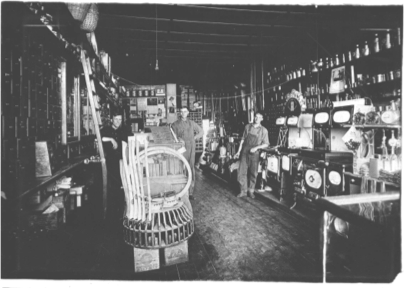
Hoplin & Nelson after 1916.  Dave Nelson, Ole Hoplin, Warren Nelson.
[Note the ladder, ax rack sitting on ammunition boxes-with irons in the middle, tungsten spark plugs, scissors, clocks, egg beaters,stoves, kerosene cans & hand tools hanging on back wall & about 6 calendars.]


The early years of the hardware business was supplying the farm community with “honest to goodness” hardware – bolts, nails, horse harness, etc.  After the 1929 crash, credit problems were rife.  Many farms were foreclosed upon by insurance companies and financial institutions.  


During the ‘20s & ‘30s, most freight arrived by railroad. The Soo Line had a weigh freight that stopped in Lowry twice a week. The dray man would deliver the freight to the business places from the depot.  The dray man also hauled material for residents, mostly coal.  When the goods were delivered to the store warehouse, each item was marked with a selling price – generally with a markup of 25%. The cost was recorded with a cost mark – a code representing the numbers 1-10. Many people tried to break the code but most gave up.  To add confusion, when a number was repeated a B or P was used - the forerunner of the bar code. In the ‘40s, a single digit representing year of purchase was added to the cost mark   e.g.  xxx – 5. At times,  it became hard to know what decade the year code represented.  


Most merchandise was ordered from salesmen who stopped weekly. Jack Hite from Glenwood would come and stay all day. Jack was an early heating expert who would figure jobs, etc. He traveled for Janney Sample Hill Co. of Minneapolis. As kids we always knew when Jack was due in town and made it a point to appear.  Jack always had a nickel for us which bought an ice cream cone. Henry Applequist represented Farwell, Ozmun & Kirk Hardware retailer of St. Paul and was a regular as well. Walt Miller represented Marshall Wells Co. out of Duluth, however shipping from Duluth was problematic as freight had to first go to Minneapolis.  The freight costs had to be included into the cost of merchandise.  


In the ‘50s Uncle Dave invested in a dealer owned distribution center known as United Hardware Co., based in Minneapolis. Freight was brought to Lowry by cattle truck over the years by Frank Bisek, Leif Dahl, Leo Dahl, Phil Wagner and the Lundblad Brothers.  Some freight was also delivered by Raymond Truck Line, which came through Lowry twice a week.  In the late ‘50s, with the advent of the computer, merchandise was ordered by “IBM” numbers without any other description. Later an electronic device with a keyboard was used to capture orders and transmit the order by modem.


Uncle Dave was a bit of a jokester and enjoyed laying it on thick to Pete Reistad, who ran a hardware in Kensington. Pete came to Lowry complaining how terrible business was.  “We haven’t had a single customer today, not one.” Uncle Dave said, “We had one earlier today”. Pete said he would be so happy to have just one customer. Uncle Dave added, ‘Of course he brought something back”. Another time, knowing Hank Applequist was due to arrive and his first stop was always the biff in the basement, Dave smeared the toilet seat with peanut butter.


In the ‘30s, Hoplin & Nelson added the Minnesota line of farm machine, initially all horse-drawn machinery: mowers, grain binders, dump rakes. As the years progressed more machinery was added to the line – a slide rake and a manure spreader. Finally, power takeoff machinery – mowers and manure spreader.  

The hardware also sold the Minnesota brand of twine. There were three grades of twine; standard, manila and pure manila, selling for 6, 6 ½ and 7 cents per pound. The twine was packed six balls to a sack, 8 lbs per ball with 2 lbs for the sack – so nominally 50 lbs. The standard twine had 500’/lb; manila 550’/lb and pure manila 600’/lb. All the machinery and twine was produced by the Minnesota State Prison in Stillwater and delivered to Lowry in cattle trucks. The machinery came in parts and had to be assembled. Assembling a binder was a full day’s work for two men. Often times the binder would be delivered knocked down to the farmstead and assembled there. The machinery business also created an ongoing parts business which was very good until the advent of tractor machinery when parts became obsolete very quickly. There were tons of parts that went to the scrap heap.  

Editor note: In the '50s & '60s the machinery business had dwindled mainly to hog feeders and an occasional hay rake. Marian & I had feeder assembly duty. She was the brains of the operation. I was there because I was small and could get inside the hog feeder to hold the bolts. No power tool aids then.


Rural electrification came to area in the late ‘30s. Dad had a master’s electrician’s license and began wiring farms all around the area.  Plumbing evolved with the installation of drinking cups in barns, supplied by gravity from an elevated storage tank. Water was delivered to the storage tanks by a force pump and overhead piping. When electricity became available, the force pumps were replaced by electric driven pump and pressure tanks and indoor plumbing arrived.


The heating sales consisted initially of the stoves that occupied every living room. The early ones were mammoth, with dozens of mica panels to make the burning coals visible. Then came the circulating heater of many different makes and models.  They usually had an enameled jacket over the heat exchanger so the cold air from the floor would rise under the jacket, be heated, and rise to the ceiling – a great improvement.  Hoplin & Nelson supplied a stove truck to anyone for free for this spring and fall task. One of the leading manufacturer was “Heatrola” and was the generic name for all stoves,  just as “Frigidare” was the name for all refrigerators.   
The Heatrola eventually gave way to oil fired parlor stoves. Women didn’t like the ash problem. There were Jungers, DuoTherm and many others. All used a pot type burner that caused a problem on low firing because the burner was not hot enough to completely vaporize the fuel – causing soot deposits.


Furnaces in basements began with single registers brought to a central point. They had a double jacket with the central jacket around the heat exchanger and rising to the round section of the square floor register. The outer jacket from the floor register was the cold air return that would drop to the bottom of the furnace and rise in the center to the heat exchanger. These systems worked very well.  All were originally hand-fired with wood and coal.  Warm air heating evolved into large pipes installed to each room and a central cold air return located centrally with wood grills in the floor. Many were subsequently converted to stoker and oil firing.


Automatic heat soon became a necessity; first draft controls from the living area stoker and oil fired systems. Propane became a fuel for heating in the ‘50s using 100 lb cylinders. This became wide-spread and was used also for cooking and water heating. There were dozens of Hoplin & Nelson customers using these tanks, mostly delivered “after supper” by Martin Heggestad. Eventually the demand for propane brought 500 and 1000 gal tanks and the 100 lb tank business faded.


The hardware business was always adjusting with new products.  In the period after WW II, consumer goods were very scarce. Farmers had electricity and were eager for appliances – refrigerators, electric stoves, small appliances were in great demand with few available. Whatever we could get we sold quickly and usually had a waiting list.


The electrical contracting business grew to include larger buildings – schools, hospitals & nursing homes.  A strong business grew in Elbow Lake, doing electrical, plumbing and heating on homes there, working with building contractor Eric Pearson.  Eric built the house at 249 Drury Ave.  


 Hardware – 30’s & 40's                                                                                        .


Before 1952, the hardware was in two buildings. The north half housed the hardware and the south half, which was unheated, the furniture.  It had a large display window with two large plate glass windows. A few pieces of furniture were displayed, floor coverings, congoleum rugs and kitchen appliances. The building had a full upstairs, used for storing seasonal merchandize, such as garden supplies, horse fly nets, fly spray – and a few caskets. Access to the upstairs was a very steep stairway which also had a large opening to the roof. A block and tackle was rigged to the rafters and heavy items were hoisted to the upper level and through the roof opening. The room contained casket display items along the south wall – eight cabinets that folded down like a Murphy bed. The cabinet had a latch and a handle that could be reached from the floor. The bottom hinge side was about two feet from the floor so that when the cabinet was lowered a small saw horse on the upper end could support it.  The caskets were strapped on the cabinet door and a block on the lower end to keep the casket from sliding down when standing upright. Often the caskets were displayed on the cabinet door. The floor also had a mattress display on a moveable mattress rack.


Hoplin & Nelson – 1953 onward


1953. Dave Nelson, Marian Heggestad, Glenn Hoplin, Maynard Nelson, Walter Svec, Art Tewes, Martin Heggestad
In 1953, Eric Pearson and his crew removed the front of the building.  He tore out the wall between the north and south, making the store size almost double.  A brick front was installed with three large thermo pane windows on each side of the front entrance.  Eric had suspended the building on posts and had enclosed the wide open front with lumber for a working enclosure.  On April 13, 1953 a tornado passed through Sedan.  Lowry experienced some wind, but there was little damage – we easily could have lost the whole thing. The project was completed with a brick and glass front and a canopy over the sidewalk, replacing the former awnings.  New display fixtures – or “islands” – were constructed and wall display cases were made.   Concrete floors were poured in the new south part as well as a new concrete wall inside the old south wall and on of the north side.


The Lowry store had a pair of loyal, dedicated employees – Martin Heggestad and his wife Marian. Martin and Dave Nelson managed the store from 1939 to 1975 when Martin & Marian retired and moved to Fergus Falls, where their daughter Lorraine lives.  Super employees for 36 years.   

Sunday, October 26, 2014

Esther's

[Editor note:  After Glenn Hoplin's remembrances of 304 Drury Ave in the 20's and 30's, I return to 1957 for a look at the same address from the next generation's perspective - the grandchildren. The “Grandma’s house” stories in this episode are a compendium of Hoplin grandchildren memories]


A grandfather's lament. Why is it always “Grandma’s House”?  Let’s go to Grandma’s house!  Poor Grandpa, hardly noticed.


In 1957,  I had the unrecognized privilege of living practically across the street from my grandmother - and grandfather.  Ole was pretty much always working, but then again, so was Esther, but she seemed so much more productive to that 10 year old, making doughnuts, cookies, baking bread, cooking delicious meals.  

Many of my memories of 304 Drury Avenue get to my brain through the nose.  The house always had wonderful aromas emanating from that big kitchen. In my memory, grandma was always in the kitchen, a kitchen with 4 entryways.  The kitchen had a huge picture window looking across the fields to the east and the Soo Line tracks beyond highway 55. Grandchildren loved to sit by the kitchen table, eat cookies and milk and wait for the noon freight and counting the cars. Sometimes it was 3.

Esther was a wonderful baker - breads, cookies of all kinds (date filled, ginger, sugar cookies, mint frosted chocolate, elephant ears), Scandinavian delicacies - krumkake, rosettes, flatbread, and the best lefse this side of Spring Grove, together with the ever present egg-coffee steaming in a glass Pyrex pot on the stove.  The entry-way on the north served as a pantry and the shelf in that space was stacked high with cookie tins, angel food cake containers and numerous pans of goodies.


But Esther’s signature item was her fantastic doughnuts which she put on a broomstick and handed out at Halloween - a must stop on the trick-or-treat rounds. Her doughnut secret was to take the doughnut out of the hot oil and dunk it in boiling water.  This removed excess oil and made Esther’s doughnuts better than any other. An added bonus, the hot water with the doughnut grease made excellent soup stock. Some would use additives, like rolling them in sugar or dunking them in coffee, but I preferred them neat.


In the 20’s, Esther had up to 12 people to feed daily - husband, father, father-in-law, 7 children, brother, and at least 9 through the 30’s until the nest began to empty in 1936.  And herself of course, although often she would not take time to sit down and eat, just downing a raw egg on the run.


I suppose it was not as often as I think I remember, but it seemed nearly every Sunday dinner during summer was at Esther’s.  The long dining room table was filled with local (I grudgingly include Brandon & Glenwood as “local”) family and frequently sons and daughters and their families from the Twin Cities or North Dakota.  Ole’s Brandon siblings made rare appearances, but Esther had brothers and cousins in Lowry, Alexandria, Fergus Falls and Kenora who appeared occasionally and were welcomed with open arms. (Esther was the only daughter in the Carl Nelson family - sister Ida died at age 2). And in the early 50’s the Latvian displaced persons (Anna “Ooma”, Angie & Julius Jegers, Vera Gailitis & Albert Vigants) were often at the Sunday feasts - they called Esther “mother”. The dining room had the necessary long table and 3 curved glass cabinets to hold the Fostoria glassware - and a big oak hutch to hold the good dishes.


The house itself was a unique design in Lowry. To me it looked like a barn.  Seemed weird until later in life I visited Sweden and saw many houses that looked like Ole & Esther’s.  The focal point of the house was the kitchen, but the dining room/living room ran the entire length of the house on the west side.  This was intentional, designed to facilitate funeral services.  It was a house endlessly interesting to explore - except for Uncle Dave’s room, which was off limits. (However, when my wife & I lived in that house in 1972 with Uncle Dave - Ole & Esther having moved to the Glenwood Retirement Home - our son Matt (age 2) had the run of Dave’s room, Dave calling him “Little Paulie”) And the south bedroom was still referred to as Grandpa Carl's room although he died in 1938.  


From the top down, there were interesting places to explore in that house.  There were 4 bedrooms on the upper level and an attic with a stairway on springs that could be pulled down from the ceiling.  I didn’t get up there often, but there were trunks of stuff up there and a WWI spiked German helmet! The basement was a little creepy with a separate entrance,  a cistern and a enameled table that looked like it should be in a morgue.


There was also a clothes chute in the upstairs hallway that tempted a young cousin to take a direct route to the basement - ending up stuck.  He may still be there.  And there was a unique clothes drying system. A wire clothes line was strung from a pole at the far east point of the lot to a pulley mounted by the back door.  You simply hung your wet clothing on the line and moved the line around the pulley - never having to move from your spot. Ingenious. And then there was this contraption that sat in the kitchen next to the entry to the dining room that looked like something from a horror movie - a "Mangler". (there is such a movie - look it up). It was used for ironing clothes and linens. Most of the sheets had large brown burn marks, but it was fast.

The driveway made a half loop around the house and was bordered with bowling ball sized whitewashed rocks.  Perhaps an idea brought home from the war, where military bases used this device to keep the troops busy endlessly painting rocks.  A grandson got rock painting duty occasionally.  Ole had DeSotos, until they went out of business, which he parked by the back door.  Uncle Dave's black Buick was parked in the front.

Apple trees lined the border to the north with Robiesons. The field of view to the east was open clear to the Soo Line tracks across 55.  The North Dakota flatlander cousins loved that "big hill" below the house.

A place chocked full of great memories.

And a bonus for you


Just so no one can claim that there is nothing of value in this episode, I include something precious: Grandma Esther’s donut recipe.


Esther was famous in Lowry for dressing up as a witch on Halloween and dispensing donuts from a broom handle. She saw every kid’s costume every year – some of us more than once. I suspect she’d get a visit from the Pope County sheriff these days.
Step 1: Assemble the equipment. Purchase a good quality mixer - Kitchenaid makes a nice one ($300); a deep fryer ($100); a donut maker ($30); a good quality exhaust fan ($2000 installed – you might do without it but you will smell donut grease for 6 weeks and in 6 weeks you will crave donuts again. This is known in my trade as an infinite loop). You should only need to do step 1 once or twice in a lifetime.
Step 2. Assemble the ingredients.
3 well beaten eggs  [Farm fresh brown eggs of course.]
2 c. white sugar
1 c. sweet milk [X-Gen translation = 1⁄2 & 1⁄2]
1 c. sour cream
1 t. salt
2 t. baking powder
1 t. soda
6 crushed cardamom seeds [This if you want authentic, but, personally, no thanks. Esther made some with and some without.]
2 t. vanilla [From Axel Erickson, the Watkin’s man. During prohibition, this was in very short supply due to its use in stills.]
5 c. flour [Better if 2 of the 5 are cake flour]
1 t. cinnamon 
1 t. nutmeg

Texture is everything. 2 of the 5 c. should be cake flour if you want it right. Ofcourse, Esther did not have this, but I think she sifted the bee-jeesus out of it. (She wouldn’t approve of my language, BTW)
Step 3. Execute to plan. This recipe involves scalding hot oil and boiling water so it must be performed by a responsible adult. This eliminates most people so I am wondering why I'm bothering.
Put the dough in the ice box over night. You can handle it with less flour that way. When each donut is cooked, have a pan of boiling water beside and plunge each one into it (Editor’s note: use a tongs) and drain on paper toweling. This takes care of any grease left on them and the shortening from the water is very good and flavorful for cookies.
Step 4: Cleanup. Hmm, what to do with that donut grease? Stash it in the cistern for reuse in 6 weeks. Throw away your cooking clothes.
Step 5: Consumption. I suspect you will squirrel away your own private stock somewhere, to be found appropriately on St. Patrick’s Day dressed in green - assuming you have any left after the execute step.

Sunday, October 19, 2014

Depression Years

Editor note:  This is the 3rd and final installment of the Glenn Hoplin reminiscences, this describing living through the depression years in Lowry.


The stock market crashed in 1929 and it became difficult to provide for 11 people.  [Editor note: Ole, Esther, 7 children, father Carl Nelson, brother Dave Nelson. Father Nils Hoplin died in 1927].  
The Depression of the 30’s was a lesson in survival. During those years, most of the payments on the Sogaarden note were not made. Had this mortgage been held by a financial institution, we would certainly have suffered foreclosure.  [Editor note:  In 1927, Ole Hoplin borrowed $7500 from the Sogaarden brothers to build the home at 304 Drury Ave.]

Many attempts were made by the Roosevelt administration to prime the economic pump – an alphabet soup of programs: WPA, PWA, NRA, CCC to name but a few. Nothing seemed to significantly improve the economy until 1939 and the war in Europe, bringing people to work producing war materials. The government programs provided money for people to exist in manner people today cannot imagine. What is called poverty today would have been deemed extreme luxury during the depression. The Hoplin family survived the depression in large degree to the generous credit arrangements of McIver’s Store and Martin & Peter Sogaarden.  [Editor note: The Hoplin Hardware Co. of Brandon was a victim of the depression, entering bankruptcy in the early 30’s]


In 1930, Dr. Gibbon died. His widow Anna asked Ole to buy the Hudson Super Six automobile. It had a hood longer than the car body, a huge engine and an insatiable appetite for gasoline. It was equipped with puncture proof tires. The depression had hit and Anna could not get rid of the vehicle, so she told dad he had to buy it for $400. She said he owed them that. It was the only family auto owned by the family other than the 1923 Overland. It was little used because it cost so much to operate.


During the ‘30s in Lowry, many youngsters were taking violin lessons from Mrs. Bill Lesley. She directed an all violin orchestra of 15-20 children scratching away at most PTA meetings. Glenwood High School had an orchestra that was heavily supplied with string players from Lowry. I was one of the diligent students, practicing perhaps up to 15 minutes a day, after which I had expended so much energy and concentration I became exhausted and laid my instrument on the davenport while I rested and considered. Brother Bud entered the scene and sat on the davenport separating the neck of the violin from its body. This terminated a very promising musical career and opened the door for Ole Bull – leaving me to a plumber’s life.


Dorothea Lange's classic Migrant Mother depicts destitute pea pickers in California, a mother of seven children, age 32, March 1936.
The economic deprivations of The Great Depression of the 1930’s were compounded by the “Dust Bowl”.  Records for hot dry weather still stand and year after year of below average rainfall parched the land. The wind blew continuously and the days were desperately hot. The sun was a red ball at high noon because of all the dust in the air. In 1934 Lake Malmedahl was dry. Most of the lakes in the area had very low water levels and trees grown on the shoreline, some with trunks of 5” diameter or more, which indicates the length of the drought conditions. The Strandness’ farmed Malmedahl’s lake bottom.  They had constructed fences to pasture cattle and grew flax.  On July 4, 1935, it began to rain, filling the lake with a single rain and ruining the crop.  The 4th of July celebration at the Fairgrounds in Glenwood found people stranded with water up to the floorboards of their cars.  There were mixed feelings - rejoicing at the desperately needed moisture - but wishing that it wouldn’t have to come in such biblical proportions.  

For several years crops were poor and livestock feed scarce. Much of the grain was so short that bundles could not be made with a binder, so the grain was cut and winnowed like hay. The threshing machines were set with the blower through the barn down and the straw blown in for livestock feed. Every growing green thing was used for feed. The fences had drifts of topsoil like snow and the trash and tumbleweed collected along the fence lines. It is impossible to imagine the poverty brought by the drought and depression unless you have experienced the devastation. And to compound matters, the winter of 1936 was the coldest in record. Most people had coal burning appliances but no money to buy coal.


The drought years alone were tough, but together with the worst depression in history, it became a terrible struggle to provide just the basic needs for a family.  Many families lost their farms and went to work at jobs provided by federal programs. The federal government instituted numerous programs.  NRA – National Recovery Act.  The CCC – Civilian Conservation Corps, a program that put young men to work with the forest service, many times working for room, board and clothing.  

In 1938 city water was installed by a PWA project. The  PWA – Public Works Administration created work for contractors.  In this program, government contracts were issued to build infrastructures in small towns and cities.  The government dictated policy and wage scales.  Laborers were given 55 cents / hour.  Many men were working for $1 a day.  Under this program, Henry Nodland Construction of Starbuck constructed the municipal water system.  The amount of the contract was so small that it’s hard to believe so much could be gotten for so little.  All the 6 & 8” cast iron water mains, hydrants, a new well and well house, a 10 HP deep well turbine pump, a 100’ water tower and tank.  Every joint in the cast iron mains were joined with oakum and molten lead.  Ditches were dug with a huge chain digger with a belt conveyor.  Backfilling was done with a drag line.

I worked for Henry Nodland for 55 cents/hour, which was fabulous. People complained that an 18 year old kid who didn’t know anything should be paid such an outlandish amount. Most of the days were 10 hours and since I lived in town, I was asked to take care of lighting all the flares and fill them with kerosene and then extinguish them in the morning. I also rose early to light the fire under the lead pot so the molten lead was ready for the 7 AM work start. I was supposed to get an extra hour’s pay for this. For several blocks the 6”, 18’ long pipes were laid along the ditch with the bell ends reversed. These then had to be turned 180 degrees into the ditch.


WPA road building in Northern Minnesota - 1933
The WPA - Work Progress Administration -provided jobs that built roads, parks, and public buildings.  The skating rink in Lowry was constructed with a warming house that has a fireplace of native rock.  The building remains to the present day, however the fireplace has been removed.  The schoolhouse was shingled, all the maple flooring in the classrooms were taken up, cleaned, re-laid and sealed.  The entire interior of the school was given a coat of Kalsomine.  The cedar trees that lined the east side of Highway 114 were moved by the WPA from directly behind the school building.  These trees had been used as enclosures for the outdoor plumbing – one for the boys and one for the girls.  There were 3-4 toilets in each enclosure with access through the trees.  Amazingly, every tree survived the transplant.  In recent years, apartments have been constructed just east of this tree line and the shade of these trees adds to the location. 

In the 1930’s, radio was in its infancy. Early radios had three batteries and you had to wear a headset to listen. Later a huge horn amplifier was placed on top of the radio. The radios had several tuning dials to try to find a station and static was standard. The telephone was a box on the wall with a crank and an operator answering “Number please?”.  Lindbergh had made his famous New York to Paris flight in 1927, but commercial flights were very limited. Very few roads were surfaced and many autos still had “side curtains”. A cup of coffee was a nickel - same price for an ice cream cone. Most homes did not have indoor plumbing – peach wrappers were prized. People helped one another and shared the little there was, produce from their gardens, milk if they had a cow. Bartered labor was a common practice – no one had money to buy things. Local merchants extended credit to people for long periods and beyond reasonableness. Most farming was with horsepower and the farmer raised his own fuel. 


Rural electrification came to area in the late ‘30s.  Dad had a master’s electrician’s license and began wiring farms all around the area.  Sometimes there were two crews working, one wiring the house and the other string yard wire from the yard pole to the buildings.  All the work was by hand.  Holes were drilled by hand with Miller Falls Corner braces.  All sawing was with hand tools.  The crews became very efficient at fishing wire in old houses.  It supplied the very basic needs – lights and a few outlets.  People were happy with this convenience after struggling with kerosene lamps that were smelly and offered little light.  The saying was “you needed to light a match to see of the lamp was burning”.  However there were vastly improved forms of non-electric light, so called Aladdin Lamps.  It burned kerosene, had a mantle and burned with beautiful white light..  The gasoline lantern had two mantles and a pressurized gasoline tank that had to have its generator heated with raw gasoline before the mantles would function.  These lamps created a fine parts business for wicks, lamp chimneys, mantles and burners.

The commodity prices during the Depression were unbelievable low.  The market was putrid. So even though the drought was broken, the suffering continued.  Not until 1939 and the onset of war in Europe did the economy improve.  Before the US entered the war after Pearl Harbor (December 7, 1941), the US supplied war materials to Great Britain under the Lend Lease program.   All kinds of materials, including ships were delivered.  After December 7, 1941, US industry converted completely to military production.  Almost all consumer goods production shut down.  Auto makers converted to tanks, airplanes, ships and other war materials.  With so many men gone to fight, much of this construction work was done by women and older men.

Every generation seems compelled to tell how tough it had it.  I remember Grandpa Nils telling how he worked building the railroad when he immigrated, working with a pick & shovel and wheelbarrow sixteen hours a day and a slave driver for a boss.  When I look at railroad grades, I see lots of wheelbarrows of dirt.  A generation later, I remember John Lind telling me “ You young whippersnappers don’t know nothing.   When you’ve dragged the ground I’ve plowed, then you’ll know something.”

[Editor notes: At the height of the Great Depression in 1932-33, it is estimated that there were 16 million unemployed, a rate exceeding 30%. Extreme unemployment drove men to ride the rails in empty boxcars looking for jobs and a “hobo culture” developed. A hobo sign-language, “Hobo Marks”, developed to warn or assist men who might cross the same path. I have no evidence, but I am convinced the Ole Hoplin residence was “marked” because a continual stream of impoverished men appeared at their doorstep looking for handouts. Esther never turned anyone away, but they were never allowed to enter the house. They would eat on the back steps.]


From The Hobo Code posted by Daniel Lew 2006
The variety of messages passed between hobos is incredible. There are some basic traveling symbols such as "go this way," "don't go that way," or "get out fast." Then there's praises and warnings of the locals - "doctor, no charge," "police officer lives here, not kind to tramps," "dangerous neighborhood," "you may sleep in barn." Some of my favorites messages I've heard of are "good lady lives here, tell a hard luck story," "fake illness here," "road spoiled, full of other hobos."  
Hobo signs were typically drawn onto utility poles using charcoal or some other type of temporary writing material that would wash out in time with the weather. Sometimes they would write on railroad trestle abutments, outcropping rocks, or even on houses when referring to those who lived inside.]